Being Contacted by Credit Collection Services (CCS)? Know Your Rights
Run a business? See how this affects your compliance obligations.
Who Is Credit Collection Services?
Credit Collection Services (“CCS”) is a third-party debt collection agency and a business unit of The CCS Companies, a Massachusetts-based collections holding company whose other units include CCS Commercial, LLC and Customer Contact Solutions, LLC. Unlike a debt buyer, CCS generally collects accounts placed with it by the original creditor (medical providers, telecom companies, and similar) rather than purchasing the debt outright — though the practical experience for a consumer being called is much the same.
Headquarters: Credit Collection Services / The CCS Companies 725 Canton Street Norwood, MA 02062
Phone numbers: (617) 965-2000 — main corporate line 1-877-870-1000 — consumer/collections line (781) 382-1000 — reported as an active collections line (781) 620-8000 — reported in consumer directories as a CCS collections number
Because CCS handles accounts for many different original creditors, the caller ID name and callback number can vary by account. If you’re contacted by a number you don’t recognize claiming to be CCS, ask for written validation identifying the original creditor and the amount claimed before discussing anything further.
Complaint Volume
The Prado Law Firm’s review of the CFPB Consumer Complaint Database (debt collection complaints, January 2023–present) found Credit Collection Services/CCS Financial Services among the higher-volume named debt collectors nationally. We did not identify a public CFPB consent order or federal enforcement action specific to CCS as of this writing; the complaint volume reflected here is drawn from the CFPB’s public complaint database rather than a litigated or settled finding of wrongdoing.
Common Complaints Consumers Report
Consumer-facing resources tracking CCS complaints most often cite disputes over medical and telecom debt that consumers say they don’t recognize or have already resolved with the original provider, along with the categories the CFPB tracks industry-wide: attempts to collect debt not owed, problems with written notice of the debt, and communication tactics.
Your Rights Under the FDCPA and TCPA
- Written validation of the debt, including the amount and the name of the original creditor, with 30 days to dispute it.
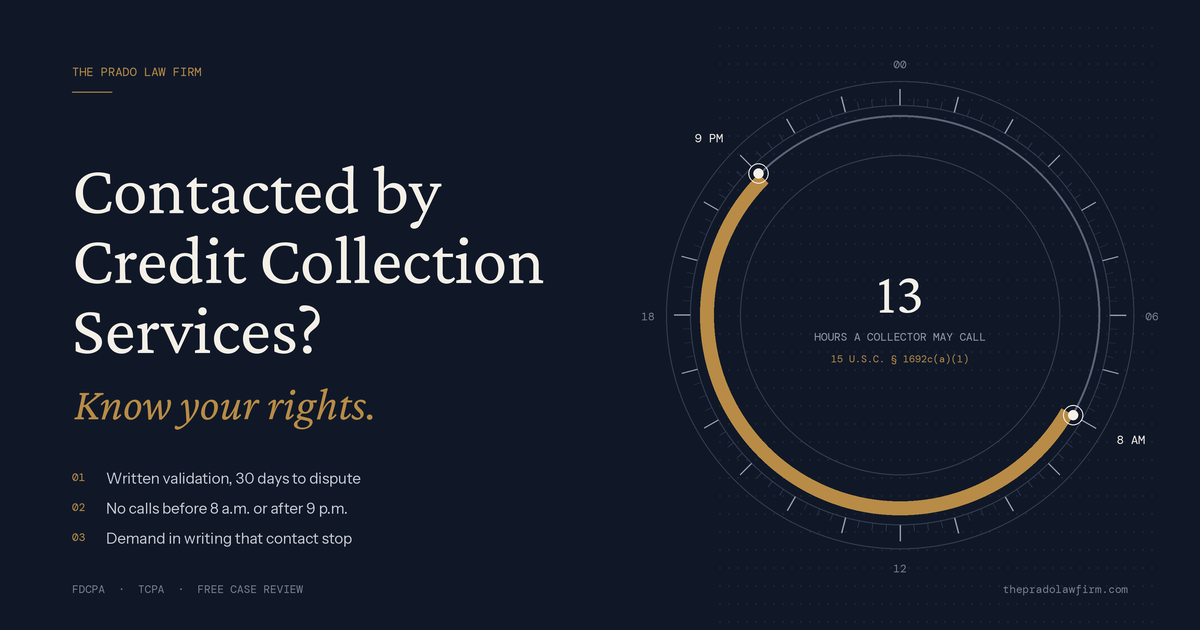
- No calls before 8 a.m. or after 9 p.m., no workplace calls once you’ve objected, and no repeated or harassing call patterns.
- The right to demand in writing that contact stop.
- Protection against collection of debt that’s already been paid, settled with the original creditor, or discharged in bankruptcy.
- The right to sue for statutory and actual damages plus attorney’s fees for FDCPA/TCPA violations — usually at no cost to you.
What To Do Next
Ask for a written validation notice, keep a record of every call (date, time, number, what was said), and check directly with the original creditor (your medical provider, phone carrier, etc.) if you don’t recognize the debt — accounts are sometimes placed in error or after a billing dispute was never resolved.
If CCS has called outside legal hours, continued contact after you disputed the debt in writing, or is pursuing an amount you’ve already paid to the original creditor, you may have a claim. Contact The Prado Law Firm for a free case review.